
Commercial construction estimating is a specialized discipline that requires knowledge of commercial building systems, market conditions, and project delivery methods. Whether you are a general contractor bidding on a commercial project or a developer planning a new development, understanding commercial construction estimating services is essential for project success. This guide covers everything you need to know about commercial construction estimating.
What Is Commercial Construction Estimating?
Commercial construction estimating is the process of predicting the costs of commercial construction projects. Unlike residential estimating, commercial estimating involves larger project scopes, more complex building systems, and a wider range of cost variables. Commercial projects include office buildings, retail centers, restaurants, warehouses, healthcare facilities, educational institutions, and mixed-use developments.
Commercial estimators must understand commercial building codes, ADA requirements, commercial MEP systems, and the specific requirements of different commercial building types. They must also be familiar with commercial construction methods, including steel framing, concrete construction, and curtain wall systems. Providers of full-service construction estimating cover all of these building types under one scope of work.
What’s Included in Commercial Construction Estimating Services
Professional commercial construction estimating services typically include:
Quantity takeoffs — Detailed measurement of all materials required for the project, including structural components, architectural finishes, and MEP systems. Commercial takeoffs are more complex than residential takeoffs due to the larger scale and greater variety of materials and systems. See how professional quantity takeoff services structure those measurements sheet by sheet.
Cost estimating — Application of current market rates to quantity takeoffs to develop total project costs. Commercial cost estimating requires knowledge of commercial material costs, labor rates, and equipment costs.
Bid preparation — Compilation of estimates into competitive bid packages, including all required forms, documentation, and supporting information. Our bid preparation services turn a finished estimate into a submission-ready package.
Value engineering — Analysis of design and material alternatives to identify cost savings without compromising quality or functionality.
Change order estimating — Pricing of scope changes during construction, including impact analysis and documentation.
Types of Commercial Construction Estimates
Commercial construction estimates are prepared at different stages of the project, each with a different level of detail and accuracy.
Conceptual estimates — Prepared during the early planning stages when design documents are limited. Conceptual estimates provide a rough order of magnitude for budgeting purposes. Accuracy is typically within 20-30% of final costs.
Preliminary estimates — Prepared when schematic design documents are available. Preliminary estimates provide more detail than conceptual estimates and are used for budget development and financing. Accuracy is typically within 15-20% of final costs.
Detailed estimates — Prepared when construction documents are substantially complete. Detailed estimates provide line-item costs for all scope items and are used for bidding and contract negotiation. Accuracy is typically within 5-10% of final costs.
Bid estimates — Final estimates prepared for submission with a bid. Bid estimates are the most detailed and accurate, reflecting the contractor’s best assessment of project costs.
Accuracy bands above follow AACE International estimate-class guidance (conceptual ≈ Class 4 ROM, preliminary ≈ Class 3, detailed ≈ Class 2). Actual accuracy depends on drawing completeness and scope clarity.
How to Choose a Commercial Construction Estimating Service
Choosing the right commercial construction estimating service is critical for project success. Consider the following factors:
Experience — Look for an estimating service with experience in your specific project type. An estimator experienced in office building construction may not have the expertise needed for a healthcare facility or industrial project.
Technology — Modern estimating requires proficiency with digital takeoff software, estimating databases, and project management tools. Ask potential providers about their technology capabilities.
References — Request references from past clients and follow up with them. Ask about the accuracy of estimates, responsiveness, and overall satisfaction.
Turnaround time — Commercial construction often involves tight deadlines. Ensure the estimating service can deliver estimates within your required timeline.
Cost — While cost should not be the only factor, it is important to understand the fee structure and ensure it fits within your budget. Our construction estimating rates for New Jersey give you a realistic baseline for what different estimate classes should cost in this market. Be wary of estimates that seem too good to be true — accuracy and completeness are more important than low cost.
Benefits of Professional Commercial Construction Estimating
Accuracy — Professional estimators have the knowledge and tools to deliver accurate cost projections, reducing the risk of budget overruns and lost profits.
Speed — Professional estimating services can deliver estimates faster than in-house staff, particularly during peak bidding periods.
Objectivity — An external estimator provides an objective assessment of project costs, free from internal biases and assumptions.
Expertise — Professional estimators bring specialized knowledge of commercial construction systems, market conditions, and cost variables that in-house staff may lack. Our team supports commercial bidders in Essex County, Bergen County, and across New Jersey with that market-specific expertise.
Risk reduction — Accurate estimates reduce the risk of underbidding (losing money) or overbidding (losing the project), improving your chances of winning profitable work.
Conclusion
Commercial construction estimating services are an essential investment for any commercial construction project. By understanding what these services include, the types of estimates available, and how to choose a provider, you can ensure your projects are accurately budgeted and competitively bid. Whether you need a single estimate or ongoing estimating support, professional estimating services can improve your project outcomes and your bottom line.
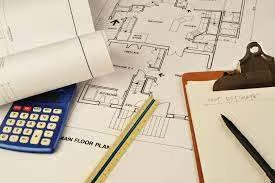
Apex Accuracy Estimating Inc. delivers accurate, bid-ready commercial estimating for contractors across New Jersey. Upload your plans for a free quote or contact our team to discuss your next project.
Apex Accuracy Estimating
Apex Accuracy Estimating Inc. provides professional construction estimating services across New Jersey. Our team of experienced estimators delivers accurate, detailed estimates for residential, commercial, and industrial projects.
Related estimating services
Bid Preparation
Professional bid preparation services in New Jersey. Competitive bid packages and proposal support for construction contractors. Get a quote.
Construction Estimating
Professional construction estimating services in New Jersey. Accurate cost projections, detailed quantity takeoffs, and reliable bid preparation. Get a quote today.
Quantity Takeoff
Professional quantity takeoff services in New Jersey. Material counts, area measurements, and volume calculations for all trades. Get a quote.
Related articles
Residential vs. Commercial Estimating: Key Differences in Pricing
Read guide →
Construction Change Orders: An Estimating Guide for Contractors
Read guide →
How a Part-Time Bid Manager Can Transform Your Landscaping Business
Read guide →Send your plans. Bid tomorrow.
Upload drawings tonight — itemized CSI takeoff with labor + materials in 24–48 hours. Free quote, no obligation.
- ✓ CSI MasterFormat sheets
- ✓ NJ labor rates
- ✓ Bid-day support