

Millwork represents one of the most detailed and labor-intensive scopes in construction. From custom cabinetry to intricate trim packages, millwork estimating requires specialized knowledge of woodworking, finishing, and installation. This guide covers everything contractors need to know about millwork estimating services and how accurate estimates improve project outcomes.
What Is Millwork?
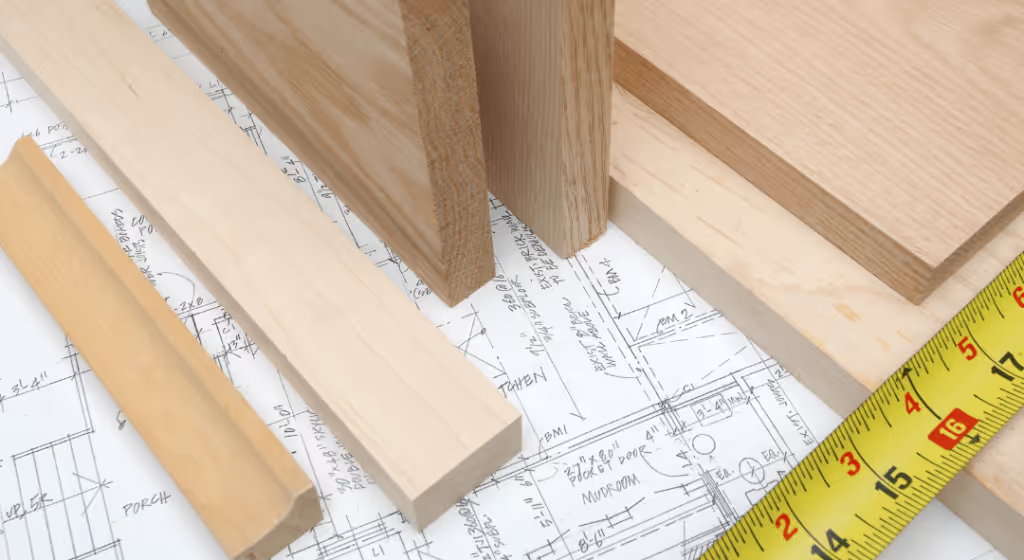
Millwork encompasses all wood products manufactured in a mill, including:
Architectural millwork — Custom and stock cabinetry, countertops, and built-in furniture
Trim and molding — Baseboards, crown molding, casing, chair rails, and wainscoting
Doors and frames — Interior and exterior doors, frames, and hardware — priced separately when a package splits them out, see doors and windows estimating
Stair systems — Stair treads, risers, balusters, handrails, and newel posts
Paneling and wall systems — Wood paneling, accent walls, and architectural wall systems
Casework — Laboratory casework, medical casework, and institutional casework
Cabinetry, casework, and trim fall squarely within millwork and carpentry estimating services, while ceilings, wall coverings, and floor finishes are priced separately under interior finishes estimating.
Why Millwork Estimating Is Challenging
Millwork estimating presents unique challenges that distinguish it from other construction trades:
Custom specifications — Millwork is often custom-designed for specific projects, requiring detailed analysis of shop drawings and specifications.
Material complexity — Millwork involves multiple material types: solid wood, veneer, MDF, plywood, and hardware. Each material has different costs and availability.
Labor intensity — Millwork installation is highly labor-intensive, requiring skilled carpenters and finishers. Labor costs typically represent 50-70% of total millwork costs.
Finish requirements — Millwork finishes — paint, stain, and clear coats — add significant cost and labor. Finish specifications must be carefully analyzed.
Coordination with other trades — Millwork must coordinate with electrical, plumbing, HVAC, and other trades. Coordination requirements add complexity to the estimate.
Components of a Millwork Estimate
A comprehensive millwork estimate includes several key components:
Material costs — Lumber, sheet goods, veneer, hardware, and finishing materials. Material costs are based on current market prices and supplier quotes.
Fabrication labor — Shop labor for cutting, assembling, and finishing millwork components. Fabrication labor is typically estimated based on historical productivity rates.
Installation labor — Field labor for delivering, setting, and installing millwork. Installation labor varies based on complexity, access, and coordination requirements.
Finishing costs — Sanding, staining, painting, and clear coating. Finishing costs are significant and often underestimated.
Equipment and tools — Specialized tools and equipment required for millwork installation.
Overhead and profit — Standard overhead and profit margins applied to direct costs.
Millwork Estimating Methods
There are several methods for estimating millwork costs:
Unit pricing — Pricing millwork by linear foot, square foot, or unit. This method is fast but less accurate for custom millwork.
Assembly pricing — Pricing millwork assemblies — such as a complete cabinet or a door frame with hardware — as a unit. This method provides better accuracy for standard assemblies.
Detailed takeoff — Performing a complete takeoff of all millwork components, including materials, labor, and finishing. This method provides the highest accuracy but requires the most time and expertise, and it is exactly what material takeoff services deliver for crews that want the quantities without the software overhead.
Historical data — Using historical cost data from similar projects to estimate millwork costs. This method is useful for preliminary estimates but should be validated with current pricing.
Tips for Accurate Millwork Estimating
Review shop drawings carefully — Millwork shop drawings provide detailed information about materials, dimensions, and specifications. Review these drawings thoroughly to ensure your estimate includes all required components.
Account for all materials — Millwork involves many material components: lumber, veneer, edge banding, hardware, adhesives, and finishing materials. Ensure your estimate includes all materials.
Include finishing costs — Finishing is a significant cost component that is often underestimated. Include all finishing operations: sanding, staining, painting, and clear coating.
Consider access and coordination — Millwork installation often occurs in finished spaces with limited access. Include costs for protection, coordination with other trades, and after-hours work if required.
Use current pricing — Millwork material and labor costs fluctuate regularly. Use current supplier quotes and labor rates for your estimates.
Add appropriate waste factors — Millwork materials have significant waste factors due to cutting, fitting, and finishing. Include waste factors of 10-20% for lumber and 5-10% for sheet goods.
Common Millwork Estimating Mistakes
Underestimating labor — Millwork installation is labor-intensive and often underestimated. Be realistic about labor hours, particularly for custom work and complex installations.
Missing hardware — Millwork hardware — hinges, slides, pulls, and fasteners — adds significant cost. Include all hardware in your estimate.
Ignoring finishing — Finishing costs are often overlooked or underestimated. Include all finishing operations in your estimate.
Forgetting coordination — Millwork must coordinate with other trades. Include coordination costs in your estimate.
Not accounting for custom work — Custom millwork costs more than stock millwork. Ensure your estimate reflects the custom nature of the work.
For contractors across Bergen County and the rest of northern New Jersey, these mistakes are most costly on high-end residential fit-outs, where trim and cabinetry packages dominate the finish budget.
Conclusion
Millwork estimating requires specialized knowledge of woodworking, materials, and installation methods. By understanding the components of a millwork estimate, using appropriate estimating methods, following tips for accuracy, and avoiding common mistakes, you can develop accurate millwork estimates that support competitive bidding and profitable project execution. Whether you estimate millwork in-house or use professional estimating services, the investment in accurate millwork estimating pays dividends through better project outcomes and stronger profit margins.
Apex Accuracy Estimating Inc. provides millwork and carpentry estimating services for contractors across New Jersey. Upload your plans for a free quote or contact our team to discuss your next project.
Apex Accuracy Estimating
Apex Accuracy Estimating Inc. provides professional construction estimating services across New Jersey. Our team of experienced estimators delivers accurate, detailed estimates for residential, commercial, and industrial projects.
Related estimating services
Interior Finishes Estimating
Comprehensive interior finishes estimating services in New Jersey. Millwork, trim, and finish cost projections. Request a quote now.
Millwork & Carpentry Estimating
Millwork and carpentry estimating in New Jersey. Casework, trim, doors and custom woodwork budgets for TI and commercial projects. Get a quote.
Related articles


Send your plans. Bid tomorrow.
Upload drawings tonight — itemized CSI takeoff with labor + materials in 24–48 hours. Free quote, no obligation.
- ✓ CSI MasterFormat sheets
- ✓ NJ labor rates
- ✓ Bid-day support